
Screen: /en/account/reviews · Counts: reviews taken in this month
Reputation triages the reviews you record, compares one period against the one before, and can draft a reply for a person to approve. Nothing here writes a review, and nothing publishes anything.
What it is for
Bad reviews get missed, and the businesses that handle them well are the ones where somebody actually did something and wrote it down. This product makes that the only way to clear the list.
Step 1 — add your profiles
For each profile: platform, the name as it appears, an optional link, and how you hold this profile.
That last field is a statement, not a verification. We cannot check that you control a profile on someone else's platform. It is recorded because a business that has written down how it holds a profile has thought about whether it should be acting on it.
Step 2 — get reviews in
Record a review one at a time, or import a CSV. Re-importing the same file is safe: a review already recorded stays one review, matched on the platform's id or a fingerprint of author, date and text.
Sentiment comes from the stars alone, never the words. 1–2 negative, 3 neutral, 4–5 positive. The customer already said how they felt; nothing here guesses on their behalf. This rule is enforced by a database constraint, not just in code.
Step 3 — the triage list
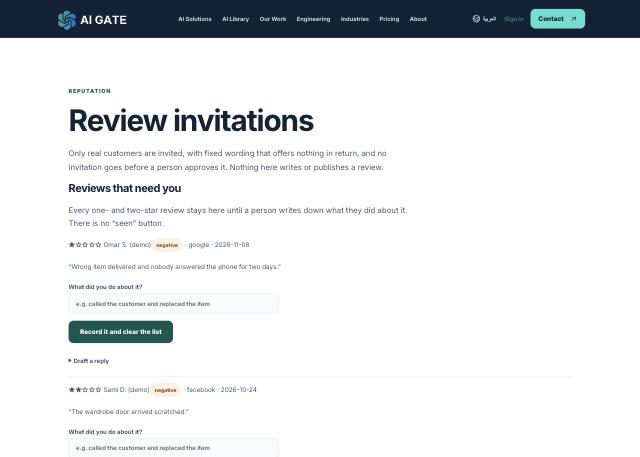
Every one- and two-star review stays on this list until somebody writes down what they did about it.
There is no "seen" button. Type what you did — "called the customer and replaced the item" — and press Record it and clear the list. An acknowledgement is all three parts or none: who, when, and what they did.
Step 4 — draft a reply (optional)
Draft a reply writes a first draft for you to edit, approve and post yourself under your own name. We hold no credentials for Google or Facebook and could not post for you if we wanted to.
The limits are enforced in code, not asked for in a prompt. A draft is refused outright if it contains a money amount, a percentage, or a link, address or phone number you did not supply. A model that ignores its instructions produces no draft rather than a promise you never made.
Both texts are kept: what the model wrote never changes, and what you approved sits beside it. Regenerating throws away any approval — an approval cannot survive the text it approved being replaced.
If no model is configured, the button is absent rather than present and failing.
Step 5 — the comparison
Your rating and count for a period, beside the period immediately before, per profile and overall.
Counted only from reviews you recorded. Nothing is projected or forecast: a review count is not a series you can extrapolate from.
Competitors
Readings you take and record, not figures we fetch. Reading a competitor's rating needs that platform's permission, and a number we inferred would look as solid as your own verified ones.
Invitations
The invitation wording is fixed and offers nothing in return — a paid-for review is a fake review. A person approves every invitation, only real customers are invited, and one customer is left alone for 90 days after being asked.
What it does not do yet
Pulling reviews automatically from Google or Trustpilot. That needs access granted by each platform, per business.